Featured post

Big Bang - not the Television series.

The thing is that as human beings we cannot contemplate the insignificance of our existence in relation to the vast reaches of what we call ...

Monday, 13 February 2017

Big Bang - not the Television series.

The thing is that as human beings we cannot contemplate the insignificance of our existence in relation to the vast reaches of what we call The Universe. The enormity of the numbers in our terms, such as 13.7 billion years, or even a few millions when our planet was developing, or the struggle to understand what happened before we were born. To add to our confusion we have to wrestle with distances that cannot be named because there are not enough words to describe a number with so many zeros tagged on. We have to resort to giving the numbers indices that run out of sensible sizes even before we reach Alpha Centaurii.


Our forbears, in various areas of our world came up with tales to explain the inexplicable reason for our existence, often also incorporating a beginning story, and they often came up with Gods or a Supreme being to solve the dilemma. There are evidently many creation stories much like the biblical Adam and Eve tale often giving a time in the past that most people could comprehend. Putting aside crank timelines for the creation of the Earth many of them successfully gave an explanation most people could cope with. 

My problem with the creation stories and the idea of God as a supreme being is the need to have faith in the idea and accept it as the truth. 

Likewise, my problem with the Big Bang Theory is the same. 

I cannot comprehend the vastness of space and like our forbears struggle with the thought that in comparison to the Universe my existence is a mere blink in the time line, and the longest journey I can make on this Earth is so short in comparison to the vast distances of space as to seem as if I have not moved. 

When I was a young man I sometimes staggered back from the Robin Hood and Little John pub on Bluebell Hill with my mate and we would gaze at the stars (you could see the buggers then) and imagine travelling to the furthest star to stand on a planet similar to Earth and imagine doing the same there. The exercise bemused our already befuddled minds, yet if taken to a logical end was terrifying because you could not imagine reaching an end. 

And then we are told we have the beginning. Not God's six days and rest on the seventh, nor the sudden creation of fully formed creatures but an explosion, a chemical and gaseous fart that spewed galaxies of stars into space. We are told that this might possibly be (a theory) the start of something big which is beyond our full understanding, and an event we hope we can actually detect. 

 When an Astronomer suggested that there was a glow behind the Big Bang a Christian Leader (bless him) made the comment that what the Astronomer saw was the Holy Light of God. 

My thought at the time was quite simply that this man of God had yet to evolve, and that perhaps the Astronomer's equipment had reached its limit of perception. It was this that prompted me to consider that perhaps we have yet to discover the real reason for the Big Bang. What if the Universe we live in is much bigger than we thought it was. 

In most religions the idea that we have a beginning and an end in all things bears out the reality of our mortality and the "mortality" of planets, stars and galaxies, replacing cold, natural indifference with something we can understand, or at least deal with. 

The Big Bang theory gives us an conceivable beginning and allows us to cope with the vastness of our Universe. 

Naturally most of us are just managing to cope with paying the rent, finding out what's on the telly, trying to cope with illnesses and relationships and all the normalities of human life. We fight our wars, complain about governments, raise our children and mourn our dead. 

Most of us say "Sod the Big Bang" and get on with our own organic and chemical explosions. But to me the thought of what went before the Big Bang occupies my thoughts, and I hope that on reading this short piece you also start speculation. 

I may be wrong but after all it is only a theory. 


https://www.facebook.com/james.apps2

Sunday, 29 January 2017

Where do all the spare gloves come from?


Walking with a friend around the Ightham Mote estate on a warm January day we realised we were overdressed for the day. I kept my hat on to stop the cool breeze freezing my bald head but soon discarded my gloves to pop them in my coat pocket.

The trek on the 'blue' trail led from the car park to the hill leading down to Mote Road and from there on past the hop picker's huts to the top of Wilmot's hill. The ground was frosty in the shade but in the sunshine it was warm with vibrant colours lit by moderately filtered sunlight. It was a beautiful day and putting aside excuses about being too fat after Christmas we rested on occasion to take in the glorious views of the North Downs.

Walking under the trees the ground was frozen but were warm.

A short stop to sit on a bench and put the world to rights was much like a Spring halt. If it was not for the frost and the sun being low in the sky it was such a day. However, with gloves tucked in my pocket, hat warming my head and coat partly undone we upped and staggered on.

Walking the route anti-clockwise so to speak meant that we reached the top of the hill gradually and was presented with a stunning view of the downward pathway under the huge trees, and the magnificent vista of the Downs and the farmland below.


We walked down the track and on to where Wilmot's Cottage nestles on the shoulder of the Downs and the track itself then leads back past Mote Farm to the House and gardens of Ightham Mote

On a fence post somebody had set a black woolen glove on top of a white one. Lovers perhaps? Perhaps they chopped a hand off each and no longer needed the gloves? Whatever the explanation there they were, abandoned and sitting like a pair of birds on the fence, their incomprehensible message as mysterious as bird song.

And I wondered why somebody would leave one single glove on a fence let alone two. It was an unusual sight.

Yet, the mystery deepens when in Paddock Wood, just exploring the town, my Sister and I came upon yet another abandoned single glove!

What is going on?

Coincidence?

And yet, like the mysterious single sock that was dropped in the street near my home, it was there.

And if that was not enough on the way back into town on Paddock Wood's Commercial Road, there was a child's gloves resting on the pavement adorned by an animal faeces.

Where do these waifs come from?

Who abandons them and why?

At least the incidents add extra interest to the walks.


Thursday, 1 December 2016

The new Queen of the Realm

Mixie
So, I went to Ireland for a pre-booked holiday, did drink Guiness, saw much of Ireland having lost my Sophie puss. I returned to an empty house but with the promise of a rescued cat from the RSPCA. I was presented with a scruffy little female who liked her tummy tickled and was on the way to recovery after some il treatment by her former owners. Because of her colour I named her Mixie, a name she totally ignores, and prepared for a long period of "getting to know you".

That was July 4th and now in November she is looking good, plays happily, is well fed and ruling the roost. Sucker.

But the thing is that I have given a home to a three year old cat who may not have lasted much longer. She is, like most cats, a good companion, demanding of attention and cranky. She fights me, attacking my proffered hand with sharp claws which she remembers to sheath now and then, demands treats and does all the things that a cat will do.

That she will not replace Sophie as "my kitten" is a point that I can argue is as true as the fact that Sophie did not replace Toots in the same way - Toots was the semi-feral cat I had as a familiar in New Zealand - but she will make her own impact on me.

She already has.

The sudden excited rush to roll over for a tummy tickle and the tenacious adherence to my lap is witness to that. The preening and grooming she does is a sign that she is content; the result being a cute looking fluffy cat with a pleased look that turns to begging for treats.

But mostly it is the way she now follows me around much of the time and loves to play at throw and fetch when a bunched up newspaper sheet is thrown for her to chase.

I like that.

She is helping to ease the memory of Sophie who lived with me for eighteen and a half years, years I can hardly forget. But welcome Mixie - come take your place.

Tuesday, 16 August 2016

Goodbye to a loving companion - how do you cope with losing a pet?

Toots
I have to say I lost my kitten - the one cat of my adult life that was truly mine from when she was a kitten. There was Toots whose companionship and intimacy was so intense that when she went I was a mass of tears.  (A bloke doesn't normally admit to that) My flatmate, unable to stand the sight of me wandering around with long face and lost look, found a kitten and declared her as a Christmas present. This was in 1998 and Sophie, as she became named, came with me from New Zealand and lived with me here in the UK.

So what happens when the creature who shares your life, takes up space on your bed, your lap, demands, and gets love, play and care is no longer there?

If you are like me then you sob, or shed tears every time you see her picture - I have one  on my desk - and remember the purring, the claws of play fighting, the fussy food fads, and the welcome purr-meow when I come home.

Sophie
Poor Sophie suffered old age but was comfortable, active and happy although as she aged she became quite deaf but always loved the place on my lap, the cuddle in bed and small treats, fresh meat for tea as well as her biscuits and cat-food.  She loved the play with a piece of string and scratched at her post but as she got older she could not keep up with the growth of her claws and placidly allowed me to clip them neatly.

But, sadly she developed a growth in her tummy that grew quickly and so we had to end her life. I was there at the end, managed to hold it in long enough to take her to be cremated and bring her ashes back to lay near my workspace.

Right, so now what?

The owner of my local cattery is a member of the Cats Protection Society and has always had association with the RSPCA.

I had booked  a holiday in Ireland for the first week in June, and poor Sophie was supposed to be looked after in the cattery whilst I wandered around Ireland drinking Guiness. So I had to wait and that was the key.

The waiting helped.

I could not replace Sophie.  Like Toots before her she had taken her place in my life as a intently as any other relationship and there is no way another animal/person can take the place of a creature you love as intensely as I did Sophie.

I was introduced to a three year old tortoiseshell female named Roxy, whose start in life was not good. She was scruffy, showing the signs of ill treatment but was responsive to being fussed. I was hooked and so agreed to take her on.

I re-named her Mixie because of her markings and at first she hid up but soon she responded to feeding and care. Her skin lost its scars and marks; her fur is thickening up and looking bright and healthy and she is putting on weight.

Mixie will not remove the memory of Sophie, as Sophie did not of Toots, but she is taking her place in my life and already after only six weeks or so is settling in to the household and helping me cope with losing a pet.

Mixie is helping me say goodbye to my loving companion Sophie, but I shall never forget her.

Mostly it is that sudden break, the fact that you can do very little but watch your pets grow old, nurture them from kitten to cat and hope that what you do makes their lives happy in return for the pleasure and companionship they give you.
Mixie

Although I could see my Sophie growing old, watch her fail and knew that she was needing more and more medical attention, I was still not prepared for her passing.

I know that living without a cat is not what I want and so I was prepared to find another one. Sophie was my kitten and I could do things like clipping her claws, cleaning her ears (gently) and being her servant, as you do with cats.

I suppose what you have to do is remember the best times, savour the fun you have with the departed pet and treat the newcomer as lovingly as its predecessor.  I hope I can give of myself to Mixie as much as I did to Sophie and to
Toots before her.

We shall see.


Sunday, 24 July 2016

I am not an artist....

But: I paint pictures.
When I started painting a few years ago, remembering my efforts as a lad, I began with water colours, took to acrylics and eventually took up oils. I discovered water mixable oil paints and started off with them rather timorously treating the water part of them like water colours and acrylic paint. The result was, shall we say "Okay" but a bit weak. I tended to work as apologetically, as if I was encroaching on the areas real artists work in and my work was dull.

That was, dull until I went to Amsterdam and visited the Van Gogh museum and gallery.

I returned from that experience with confidence and began to work again. I talked with my now departed friend, Bob Collins, who nodded and smiled, and gave me some ideas and encouragement. 'Slap it on but be positive and paint what is in your mind. What you see and what others see is different but the same,' he said to me. I understood that because he was the best water colour artist I have ever met, and was not inclined to butter me up.

The result was that I painted some local views and let my feelings for the mood of the day influence my paintings. Okay, so I just painted what I saw and then I learned how to use the oil paint. The painting, The Bridleway, has the elements of Van Gogh's wheat field painting, a touch of Provence in the format and the bold extravagance of his brushwork.

As you can see the painting has the elements of Van Gogh's style and I make no apologies for the similarities.

The technique was, first outline the scene in light colours such as the sky area, the track and the wheat fields.  This was done by mixing the basic colour, yellow ochre for the fields, light blue for the sky and a grey blue for the track using water to thin the paint as well as the linseed oil and medium. Let it touch dry and then start, first with the sky using only the oil and medium, adding the fields with red, yellow and white. Detail was added as the heavy paint was drying to allow it to key into the main painting.

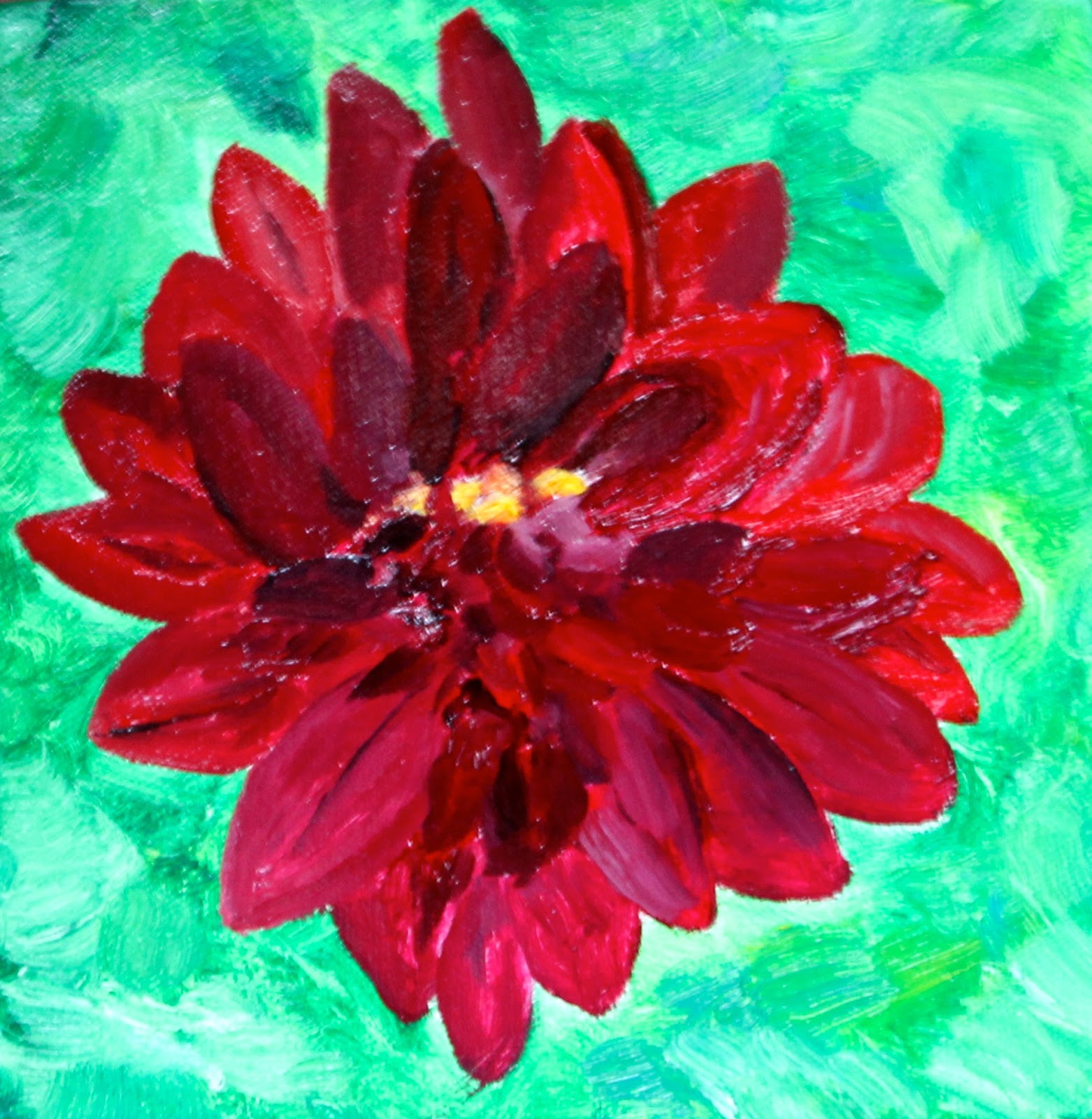
The next painting was much bolder. The basic colour was washed on using water as the thinner, again allowed to dry and then using medium and oil with the colour lay it on thick. This time I had drawn the flower on to a sheet of paper, traced it on clear tracing paper and transferred the image to the painting surface, fixed it with a spray. Initially I painted the the outline with thinned colour, added the   the trellis work plus the background foliage and the snail.

Next it was a matter of concentrating on the flower and that was done with oil and medium, and afterwards the when dry the whole was covered with three coats of clear varnish.

The third painting is a recent picture, not yet completed which I have first overpainted with an acrylic coat of white, used a heavy oil and medium coat of colour using bold brush strokes in greens as a base on which to paint a drawn and traced Dahlia bloom.

This is a work in progress and will need some more work on it when the base is dry.

What have I learned from the exercises?

Firstly not to rely too much on the water thinning but to use it when I need to help the paint to flow but mostly to paint the base colours on which to paint the main picture.

Next, to treat the paint the same as regular oil paint and be glad of its versatility.

To take care to draw the main scene and fix it, bearing in mind that if I use charcoal I can blend the dark lines in with the paint and use them as guides for the eye that will show the contrasts. I also found that working the colour by placing colour on colour and letting them blend is most satisfactory.

And lastly, not to care much what others do and think unless I can learn to use their skills.

Using water mixable oil paints is worth the effort although the colours offered are limited, but if you select the paints you need for your preferred palette you can do all that you wish. You should be prepared to buy the appropriate oil, medium and of course be aware that true oil paints will not mix, but otherwise there is no difference in response to true oil paint.

I am glad to say that I am enjoying the medium.


Thursday, 24 March 2016

Charity - it seems is big business.

I like to give to charities I agree with but I do not like being coerced into giving.  That, I believe is what many of us will agree with. The annual Poppy appeal, the Macmillan Coffee mornings, the Red Cross and other deserving charities.  Each of these and many others compete for my equivalent of the "widow's mite", and I will give what I can when I feel like it.  I also believe many of us also like to do that too without having to commit to regular amount, unless of course you choose to do so.

Chuggers on the streets seem to attack you with a similar spiel to the telephone sales techniques of the double glazing companies of the past, and become persistent in their pursuit of a monthly sum.  There are other organisations, equally as worthy of funding as any other, dealing with Birds, Asthma , Dementia, Cats, Dogs and Cancers that are all worth a penny or two asking for money.  Some I would give to, others I will not; my choice and my prerogative to refuse.

Also it is my choice to give one sum when and if I wish without being asked again.

The days of the rattling collection box seem to be numbered, although there are many retail outlets that have marked collection boxes on their counters to collect coins.  These are limited to a fairly narrow range of charities which means that if I wish to give I have to make on-line or postal contact.

If I send a cheque as a donation once, I expect that to be the end of it but what happens?

You guessed it, a mail drop, continuous bombardments of raffle tickets, rubbish gifts and cards fit only for the bin, literature including exhortations to fill in a form to send a regular amount.  At first you think that the "letter" is a one off until you receive more at intervals throughout the year at a cost to the charity that more than likely has eaten into the cheque sent.

The pattern is similar in most of them. The literature and the promotion complete with identified named labels "for your convenience" to save you writing your information on the butts of the raffle tickets you are expected to buy. I note that the number of books is now three with ten tickets each adding up to a sum of £30.00 in total - I reserve that amount for my weekly groceries.

I received telephone calls, and I emphasise calls, from the RSPB asking me to increase my small monthly amount each month, and spent some time on the telephone during the first call explaining that as I also have a monthly amount with another charity I would not increase the amount. All to no avail. I received another similar call from two more charities asking the same with similar persistence;  same pattern, same steady grind to squeeze more money.

The result was that I assumed the charities were now taking on business style hard sell and so I cancelled my subscriptions. Now I get literature from some which I open but usually, once I have salvaged the free pens, throw in the re-cycling bin.

I want to give to charities of my choice but I am getting fed up with the amount of money wasted on sending out oodles of envelopes to try and persuade me to give.

I will give when I want to and how I want to. I do not want to be bombarded with postal rubbish.

I would like to know what others think.

Wednesday, 2 March 2016

A Story of a City Down Under - And Darkly Glows the City

And Darkly Glows the City

This tale is one that was in my mind for a long time, and eventually after a number of attempts to find a format that would not only tell the tale but be readable, balancing out the dark side with a sense of hope and humour, I eventually managed a satisfying story.

If that last sounds a little pretentious then please bear with me. In the 1980's in Auckland there was a largish number of Street Kids living rough in the city. They were considered to be a nuisance to shoppers, tourists and shop keepers who called for a solution to the problem. The general opinion was to just get them off the streets, perhaps lock them up or return them to their homes. Some Councillors, Police Officers, Child Protection Groups and the Auckland Trade Unions set up refuges for them with a view to solving the problem by helping the youngsters more or less on their terms. The authorities were horrified and deeply concerned when there were rumours that some children were disappearing off the streets unaccounted for; the suggestion was that some were abducted into the child slave trade.  Whether it was true or not investigations discovered some nasty men preying on the more vulnerable rough sleepers.


I wanted to write about this dreadful "trade" and so turned it into a thriller using the Street Kid story as a background.  I always like the idea of humour even when telling a tale that is redolent with horrific scenes, and so when my investigating officers Detective Inspector Conrad O'Grady meets his new working partner Detective Constable Roy Rogers it is inevitable that there will some corny jokes. Rogers is of course named "Tex" and as the case develops so too does their friendship which gave me a chance to offset the horror of their antagonists story with some normal, romantic and family interactions.

Set in the city of Auckland the action takes O'Grady and Rogers South to Manukau city, and North to the township of Wellsford and the sandy east coast near Mangawhai Heads, and Te Aria Point which were all fascinating places to me.


Darkly Glows the City

When Detective Inspector Conrad O’Grady is called in to investigate a gruesome murder in one of Auckland’s richest suburbs he is not aware of the corruption and horror his investigation will uncover.  Assisted by rookie detective, Roy ‘Tex’ Rogers, O’Grady steadily discovers the answers to the riddle in his own rough and ready way.  

His progress is followed closely by the evil Fat Man who is determined to stop him finding out what is going on in the exclusive Downtown Athena Club.  

Facing opposition from his superiors, and having to come to terms with the dreadful series of killing linked by the book Macabre Verses and a threat to his life O’Grady finds himself in a race against time to save those he loves from a terrible death.  

O’Grady’s story is not just the tale of a detective doing his job, but a story of compassion, strong emotions, powerful love stories and that of ordinary people caught up in unbelievable horror that could shatter their lives. 

It is also the story of two remarkable young people who reconcile their cultural differences. 


The tale has a theme of Satanic Possession which challenges Fr Brien's faith in the power of the Church and threatens to wreck O'Grady's career. The forces against the pair and Rogers are overwhelming and I have to admit that balancing out that part of the tale with story of Sam, the Street Kid involved was tricky. I hope I have managed it.

This is not a tale for the squeamish but those who have read it have said they could not put it down wanting to know what was happening next. I tried to capture that sense of urgency and hopefully create and entertaining story.

In this short piece I hope that I have given an insight into the way I have developed the story and that people will want to read it. I enjoyed writing it. And finally, below, let the back cover sum up the story.

Monday, 21 December 2015

A Book of Poems - The Kowhai and Me

The Kowhai and Me 

This is a collection of my poems some from New Zealand, hence the title and others written in the UK.  To explain; the Kowhai tree blooms in Spring producing yellow, hanging bell-like flowers the native Tui bird loves.  It is the signal that Winter is past and, if the air is not already heady with new, fresh scents, it will add its own to the warming atmosphere and balmy airs.  Many in New Zealand take the tree for granted but as many quietly appreciate it, and in Auckland look forward to the magnificent Pohutukawa with its deep red Christmas blooms and dark green foliage. The Kowhai is a subtle tree that, to me, along with the felled Kauri and the marching Radiata grown for its building timber, was all part of the symbols of colonial occupation that belied the phrase "New Zealand is like a little England" - it is not so; it is nation built from colonists who in their own way "discovered" the land and made it their own.

The Kiwi is a different person from the British - Auckland is a Polynesian  City, as much as it is a Maori homeland changed by the influx of English with a view to settling, and the Irish whose migration in the 1840's included New Zealand.

The language may be English but more so now it is also Maori, and although I use my own language, English, in these poems there is smattering of Maori words but I am a colonist, living there as a paid guest who grew to love the land and the people who belonged there.

However, here are two poems: the first in memory of an evening spent with a good friend and the other a brief glimpse of the city seen as I walked from the University to catch the bus home.

A lighthouse house


we sit, 
you talking to your deaf mother
I sip your wine
I watch the sun kiss the pines goodnight;
cooking whispers seductively through 
my thoughts and catches the sea breeze;
you place the telephone out of reach
and we put the world to rights;
you feed me steak and baked potatoes
with salad and fresh beans;
I pour wine into glasses
( I could carve the meat if you let me )
we drink to Bean Rock;
you read my poems; 
I trace the moon 
through a window and imagine
I am a howling dog
or a wolf in the trees;
sometimes the day is like that

(Dinner with Pat Newcomb in her house on the cliff at Torbay on the North Shore. The house was designed in the pattern of Bean Rock Lighthouse in Auckland’s Waitemata harbour
sometimes the day is like that

 Auckland City


Albert Park


Like stone washed jeans, grey boughs
sway, windswept palms guarding,
a tranquil retreat from raucous
grinding traffic.
Jealous of lovers’ trysts
And quiet contemplation
this is my city - bathed in sunlight:
washed in winter rain -
in the streets
from chrome plated stalls
and plate glass windows, hawking wares
paid for by traveller’s cheque
a hundred fountains
in gardens of a million flowers,
and the chatter of a hundred tongues.


Sunday, 20 December 2015

A Christmas Story

Christmas Carols. 


Sam the Scam looked at the crowd around Tiny Tim and Orphan Annie and was well pleased. He could see the punters putting their spare change in the hat behind which Little Oliver was sitting playing his flute. Tiny Tim’s crutch was just the right sort, modern yet it looked like its Victorian counterpart.  All three looked mildly malnourished.  
The kids were doing all right singing and playing Christmas songs, all the old favourites and especially when Tiny Tim sang Once in Royal David’s City; it was a real treat to hear his sweet voice burbling out the words with Orphan Annie backing him softly and Oliver playing the melody so tunefully. Even better was when the coins kept slapping into the hat. 
Sam looked across the mall and caught Maisie’s casual glance.  
All clear. 
Orphan Annie gave them a rendering of Silent Night and the trio finished with a good rousing Hark the Herald Angels Sing and just in time because Maisie signalled to roll it up. Sam walked past the little group and swiftly the youngsters packed away and moved on. Sam was proud of them when they stayed in character until they were outside where he and Maisie caught up. Sam took the money and shook it into his copious shoulder bag, and the little troupe hurried away. 
Sam figured they were at least one step away from being nicked, but it was working.
‘Right, we move on folks,’ Sam said, and guided his little flock to a spot where he and Maisie could keep a look out and the escape route led them to the car. 
The Christmas shoppers were generous this year so it seemed but the authorities were not so keen and to help out Maisie had cobbled up a pretty poster declaring that they were collecting for charity which explained the costumes and names. The punters seemed to like that.  
‘And what charity are you subscribing to Sonny?’ Asked a gentleman dressed in an expensive looking overcoat, and a smart hat carrying who was prepared to give a note. 
‘It’s for a children’s Christmas party sir,’ said Oliver. 
The man beamed at him and put the note in the hat and patted him on the head.
‘Good boy, good boy,’ the Gentleman said.
‘Thank you sir,’ said Oliver giving the gentleman a smile. ‘And a Merry Christmas to you sir.’
‘He’s learning,’ muttered Sam. Oliver hated being patted on the head and detested being called Sonny. Sam chuckled as Oliver picked up the flute and managed a surreptitious two fingered gesture as he began to play.  
Maisie gave the warning partway through God Save Ye Merry Gentlemen and with a quick pip on his instrument Oliver stopped playing and they all packed up and moved off. 
‘To the car and off,’ Maisie said. ‘We been bleedin’ rumbled.’ 
What happened next will stick in Sam’s mind for the rest of his ‘bleedin’ natural’. He operated the lock with the remote, they piled in and he started the engine turned the wheel to move off and scraped to a clunking stop. Sam got out and looked at the rear offside wheel. 
‘Bloody clamped!’ 
And coppers. 
There was a gang of police officers in uniform. One inviting Maisie to alight and others ordering the kids out. 
‘Bugger,’ said Sam. ‘We been nicked.’ 
Afterwards, when the nightmare was over, Sam the Scam had to agree that the Beak had a point. But to see all his hard earned cash wasted like that was a heartache too much for any man to bear. 
‘Samuel, my good man,’ said Sergeant Burrows grinning broadly as he helped Sam with the hat and the false beard, ‘on behalf of the Salvation Army and my lads and lassies in your friendly local police force, I would like to thank you for your generous donation of time and money to what is a most worthy cause.’ 
But playing Santa for a crowd of noisy kids, being forced to hand over the day’s takings and his own brood and Maisie acting as bloody skivvies, was not his idea of fun. 
Sam knew he was sunk when as they were ushered into the court room who should be on the bench but the gentleman in the expensive overcoat. 
‘Ah mister Cooper, it seems we must meet again. I suggest the punishment fit the crime,’ he announced and that was it.  
‘Do it proper Samuel and you get your motor back,’ said Burrows.
He Ho ho ho’d almost enthusiastically, put up with a procession of small children expecting him to be nice. Most humiliating of all he had to witness his little troupe of singers perform for free.
It was heartbreaking. 
Driving back home after the party the family was silent until Tiny Tim said: ‘I got an idea.’ 
And at last, making up for their recent losses performing in a shopping mall near you Sam the Scam’s small troupe of Salvation Army look-a-likes will sing well known hymns and Christmas Carols for your delectation. 

And naturally, at this joyful season of the year, the proceeds will go to a worthy, and deserving cause. 

Friday, 8 May 2015

After the Ballot Box


Now that the election is over, and the results are in favour once again of a single party when there are many others parties with a voice needing to be heard it is time perhaps to make it possible for those voices to be heard?


Just a few rounded up figures to show what I mean:

Conservatives approximately 11million votes.
Labour approximately 9 million votes.
The rest approximately 10 million votes.

Of those ten million over 3 million went to UKIP.

This last figure shows that there was a lot of people voting for UKIP, which reflects the spurious popularity of the party and its ideas, perhaps as much as it does the protest against the major parties.  The Liberal Democrats were subsumed as part of that protest which could be that the Conservative campaign did a good hatchet job on Clegg, or the coalition was not popular.

The Labour party leader did nothing for the party by using yet another 'spin doctor' who seemed bent on nobbling Labour's relationship with the SNP and also suffered from its Scottish referendum approach.

The losers are the minor parties.

Like them or dislike them, the Ukippers deserved a few seats in the new parliament and some of the other minor parties could have seats if the seats were doled out on a proportional basis.  In effect approximately 30% of the parliamentary seats could have gone to the smaller parties and that includes in this election the Liberal Democrats who polled 7.9% against UKIP's 12.6%.

I lived in New Zealand for many years and witnessed, and was also involved in the action, the first Mixed Member Proportional (MMP) election and although it seemed like a mess it worked.

How does MMP work?

Parliament is divided into two sections.
Half elected Party seats and half elected candidate seats.
Each party has a list - for example: the larger parties will have lists starting with the leader to the last candidate.
Each seat is contested as usual but instead of having just the names of the candidates on the voting slip there is also a list of parties.

The voter will put a mark against their preferred candidate and another against the party of their choice.

Example:  In Sittingbourne and Sheppey a voter could choose Gordon Henderson and either vote for the Conservative party or choose the Green party, or if they were not happy with Gordon but liked the Conservatives then they can choose the Tory party and vote for perhaps the UKIP candidate.

The vote is then counted in favour of the candidate - there can also be a preference  system where the voter chooses a second and third candidate in which the preferences are counted and passed on - and to choose the party the votes are counted and apportioned nationally.

When the candidate list is filled (in the UK that would be 325 seats) then the next people on the party lists will be called on until all seats are filled.

This means that it would be rare for one party to govern with about half the seats and instead, because  the majority party would have to negotiate with other parties no single ideology could take control and thus eliminate unfair situations.

Note that the word coalition is not used - a coalition is no better than the current situation.

Adopting MMP would give the disaffected a chance to have a voice in government, possibly engage those who see little or nothing for them in the current system, and give small, or minority parties a chance to put their points of view in government.

MMP will also have the advantage of showing up the undesirable parties for what they are.  If this means eliminating some from the political scene and adding those whose voice is not heard then perhaps the electorate will respond.

MMP can be cumbersome, but because of this it acts as a check on legislation that would be otherwise hurried through when it needs to be scrutinised and opposed properly and effectively. It also allows parties to work together and be more willing to form all party Select Committees that work across the board as apolitical units.

James Apps. MA Eng. Litt.


Sunday, 31 August 2014

Returning to the fold

It has been a while since I have used this site and I note that the last post was on Hastings and a visit that took us by surprise.  So, recently we have been to a village not far from Hastings on the route I used to take when going there with my mates and my brothers on motorcycles.  No, we did not join in the madness of the media frenzy and the punch-ups between Mods and Rockers. I liked the Rolling Stones and The Who equally.   I didn't ride a scooter but I had good friends who did and between us we managed to avoid the chaos.
I think this is a 1926 500cc


All these years later my sister and I went to Seddlescombe about 7 miles from Hastings and wandered around enjoying the place accompanied by Poppy the dog.  We had a good lunch at The Queen's Head public house, saw the resident wandering geese and admired the village for its mixture of ancient and modern houses and pretty gardens.

We discovered the woodlands where we could walk the dog, watched people playing soccer, had chats with people we met and generally enjoyed the day.
Restored Capri Scooter

I am aware that the recent anniversary ( 50 years I think) of the incidents happened this year - ironically it was 100 years ago that WW1 began - and the stroll around the village was a reminder.

On the walk we met  up with and chatted to a resident who owns three Italian Capri scooters, one restored and two he is getting ready to work on.   Parked on its rear stand outside the Queen's Head was a 1920's Norton Single Cylinder motorcycle in good working order.  The owner rides to the pub for a drink on one of his pre-war bikes.

The Mods and Rockers, if not actually meeting up were definitely present, both peacefully following their chosen hobbies.  Nice that.

Sunday, 12 June 2011

Are We Not Supposed to See the Sea?

Bandstand - Alexandra Park


We went to Hastings, not like Harold and William in 1066, to have a fight but on a whim to have a wander obeying a  recent urge to "do" the seaside towns.  Having to avoid the M20 crossing at Maidstone we took the long way around to get to Hastings via the M2, Boxley, Wateringbury and the A21.  It was a pleasant drive and we anticipated a walk with the dog Zoid around the seaside town.  We had a bag of cash between us ready to feed the greedy meters and somewhat anticipated breezy ozone, the smell of fish and chips, candy-floss and all the sights of the seaside; we were even prepared for flocks of hungry seagulls.

Well, we got the seagulls and the smell of fish and chips but instead of wandering the seafront and the town we stopped at Alexandra Park on our way in to the seafront.  We found a free parking spot, a bonus, the coins could be spent on coffee instead, and with the dog on the lead we began to explore.

Typical Seaside Houses
Cold for the time of year but mostly sunny with the promise of showers we took to the pathways.  First stop was the toilets and on the way we located the cafe and admired the bandstand, but was most impressive after our call of nature was the walk in the well laid our park with its lakes and well laid out beds, the stream and bridges and having the pleasure of seeing the typical seaside town buildings bordering the park.  The colorful and ornate facades, neat gardens and balconies with the palms and large trees growing give the place an exotic atmosphere that smacks of holidays and days out with the bucket and spade.

Alexandra Park is quite extensive housing two reservoirs, one on the main park area and the other on the southwestern arm with an extension beyond the main reservoir to Old Roar Ghylls, the nature reserve  where ferns and water abound and apart from the occasional reminder from traffic noise that you are in a large town you could imagine yourself in the hills.

Squirrel playing the crowd
Walking was casual and we stopped to watch the birds and animals including cheeky Squirrels cadging for food, seagulls that were content to leave their exits to the last moment.  We noted that the pigeons have it sussed - take food from the fingers and you get more; likewise the Squirrels seemed to pop out of the trees exuding cuteness in the expectation of being given a morsel or two.   Their success rate was extremely high.

There was rain.  We sat at a table outside the cafe eating cheese sticks and macaroons with a cup of coffee each and the dog quietly begging underneath and  for a while it poured.  We had some shelter and a rain coats to put on.   However, we finished coffee, waited for the rain to ease and went back to the car to get a rain cover for Zoid and for sister to put her raincoat on.
Rose Gardens

From there we walked to the rose gardens and the Peace Garden, wandered past the miniature railway noting that it appeared to have a tunnel for the adults to scream in as it passes through.  Beyond that a squirrel popped out out, did its "ain't I cute" act and gained a treat from us.  Wander then around the reservoir, see the swans and in a pond further up see ducklings.  From there the Ghylls begin and this is where the rain made it presence felt having given the woods and banks a freshener there was sunlight and water and sparkling ferns.  The park is integrated into the town and now and then one pops out onto a street and then finds a way back into the woods.

We walked back along the streets to try and get a glimpse of the sea but the park is a little too far back in the town for that so we decided that another trip on another day would be a good idea.  This time we will take the bucket and spade.

Sunday, 29 May 2011

A short walk around Hever

The Henry VII at Hever
We took a stroll around the area rather than the castle and the village. The day was cloudy and cool but Zoid the dog needed a walk and when I arrived he was eager to get going. The aim was to have  lunch, a pleasant, enjoyable lunch to mark my birthday so the priority was a dog friendly pub with good food.  We also wanted to to go for a walk without lots of crowds or to encroach on a beach where Zoid would be unwelcome (by the local authoroites). This England of health and safety, no dogs allowed, rules and regulations with an ever increasing burden of political correctness and box ticking paperwork.


This last is triggered by the demise of a local, popular event - the Queenborough Pirates event with new restrictions on walking the plank and the unfortunate fact that the Police are no longer allowed to thump Oiks who spoil fun events and the postponement of the Music on the Green at Bearsted near Maidstone due to excessive demands of health and safety rules and tight event compliance.  Boring!

Gripe over.  We arrived at Hever after a pleasant drive from Borough Green through to Tonbridge and Liegh and parked in the Henry VII car park.  After piddling the dog and walking him around a for a while we went inside for lunch.  Dog welcome and staff pleasant.  My pint of Early Bird was excellent and we ordered lunch.  Sister had a baguette with her favorite smoked salmon filling and I settled for the steak and kidney pud. Loverly!  Nice price too.
Carriage at Hever Station


The Henry VII is worth the stop and if the weather had been nicer a meal in the garden with a magnificent view would have been even better.

The walk we did was from the Primary School, there is a path leading to a road where you turn left and follow another footpath into and along a paddock, the entrance is gated.  We made the mistake of not going far enough and crossed the field to another path which brought us back onto the road again further down.  However, we went past some houses and a small row of cottages to turn left, and a about a hundred metres further on we turned into the road leading to Hever railway station.  Worth a visit this for the views over the valley.  The station is the offices of  a company with the initials DPL who are keeping the building in excellent condition; it is a pity there are no flowers or gardens added (Mr Beeching of the 1960's would be pleased at the cuts).  Most peculiar was the old First Class carriage set up in the car park with steps and a platform leading up to it - what is this used for?

Pretty lake 
We crossed the rail bridge and walked the path on the other side having noted on the way up a path leading to Hever which we wanted to take.  This path up from the station joined the Edenway path that wanders around the river Eden and on to Penshurst.  The treat on the way to the road we could see from the station was the cottage with the beautiful fenced garden and formal rose garden and the walkway in the trees  leading to a meadowland wild flower patch buffered by a rough, natural area just right for wildlife close to the road.

We took the path and at the first stile we stopped - two reasons - getting the dog over or under it, solved by a neat bit of biscuit bribery, and because facing us was a lake and a gardens that appeared to be part of an estate.  Rabbits and  a flash of water lilies and the meandering building that topped the hill above stopped us in our tracks to admire it and enjoy the view.
Hever Church with dog and Sister
We discovered later that the lake belonged to the property alongside the pathway, put there for trout fishing , the lake now filled with carp.  Zoid was barked at by the property owner's Labrador.

We followed the path to the lane and turned right walking past the house we had seen from the lake which turned out to be Hever Grange and headed for the Greyhound Pub approximately 600metres from the junction below the grange.  We saw a nice neat row of houses on our left and failed to recognise that we had passed them earlier; realised it and carried on past the end of the station road to the Greyhound.  there is a path there which led back to our starting point - the school alongside the pub. You reach a junction of pathways and take the lefthand one.
A view across to the Castle entrance from the churchyard
Just to say we had seen it we took a stroll around the church and explored the footpath beyond turning back when we saw it would take us a fair way past the castle grounds on a long loop back to the village. Besides, after a lunch and it being a casual walk we decided that we had done enough.  There is always more to see but later we will return and have a wander around the castle.

Thursday, 19 May 2011

What the Dickens! Rochester & Castle

Eastgate House

On a day that began warm, a Saturday, and not taking a stroll elsewhere with my walking companions I decided a trip to Rochester Castle was a good idea. I used the park and ride at the top of City Way near Horsted to park the car and take the free bus into Chatham and Rochester.  As a certain ancient comedian and entertainer used to say "A good idea Son" and so it proved to be.  From the bust stop I walked casually into the pedestrianised high street, an extension or part of Watling Street as far as the art shop, Frances Iles, where I examined the goods - on the way back I purchased some water color paper.

But first, the Roman Wall and Eastgate.

The wall faces on to a car park and I could imagine horses instead of cars, and citizens, peasants and slaves looked upon by soldiers milling around shifting goods instead of shoppers forking out for parking and perhaps there for some purpose similar to mine, a little shopping and some sight seeing. And even in the increasing cloud there was still plenty to see.  I imagined the Romans doing their bit, using the river and the land around living in a busy town and controlling the crossing perhaps with a wooden bridge spanning the Medway.  As I passed by the wall, noting a man getting ready with a brass instrument to busk, was aware of the later occupation by the Normans - they stuck a castle on top of a hill to make their point - and how much their influence had shaped the city.
I can see you!

Beyond the wall at Eastgate House there are gardens and the place where Dickens' Chalet now sits, a rather incongruous but historic addition.  It backs on to the old Alms houses where six men of the parish were able to lodge.  In recent years the high street carries mostly pedestrian traffic and the motor traffic is redirected around the centre and along a wide road, nicely out of the way until you reach the bridge and apart from the odd glimpse along side streets one is not aware of it.

We have to mention Dickens and his influence on Rochester because there are reminders of his presence in the city and in Chatham. He lived at Gads Hill in Higham where he wrote some of his works and of course Rochester was the setting for Satis House (named as the place opposite The Vines) and the hub of Pip's adventures in Great Expectations. The annual Dickens Festival is well attended involving residents and enthusiasts from Kent and attracting many visitors.

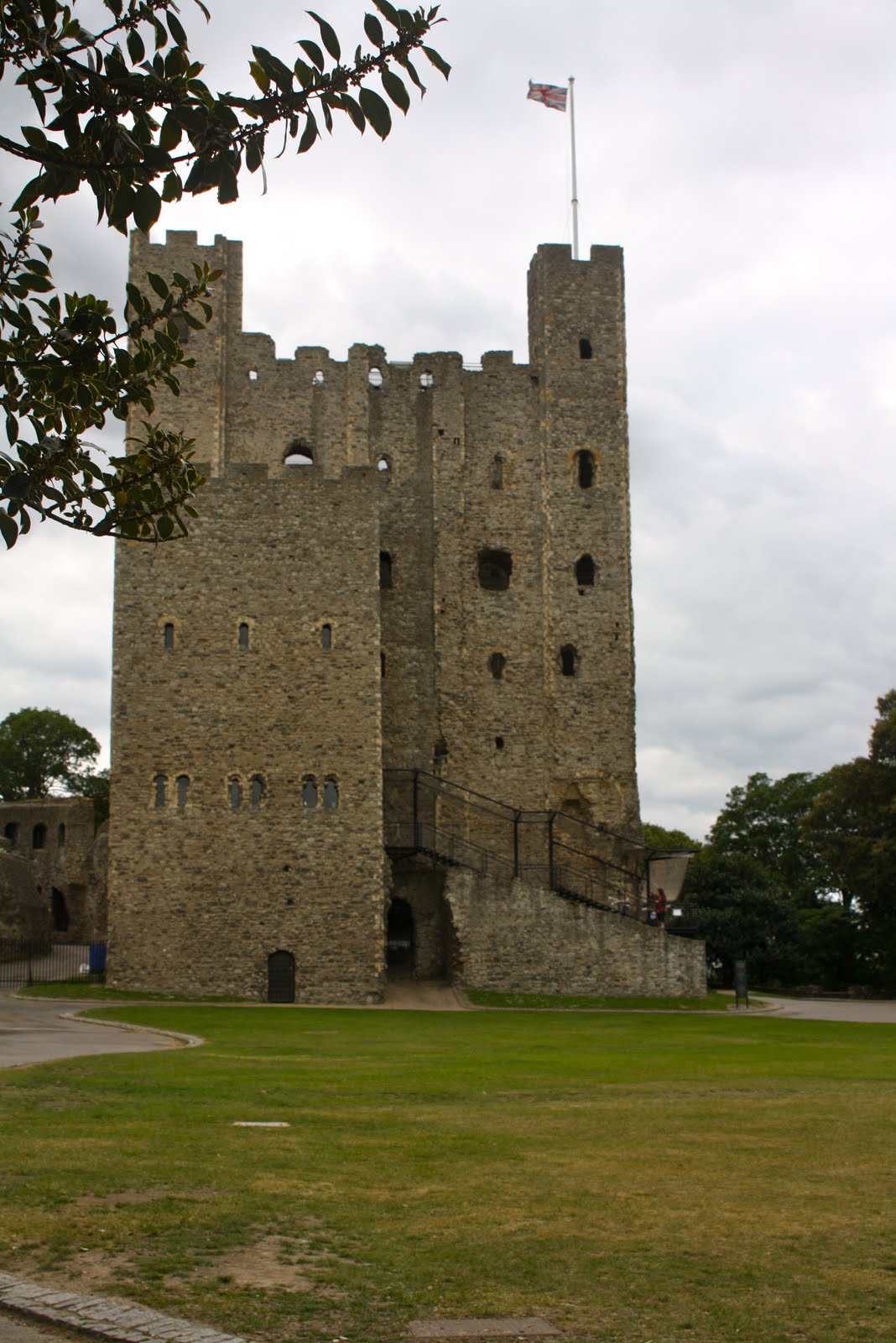
But dominating the city is the Norman castle and the Cathedral both worth a visit.  On this day I chose the castle and although the sky clouded over and became quite cold I took body and camera to the grounds and using my English Heritage card I entered and took the tour.  With the aid of  a handset (hire price £1) I wandered around from the portcullis entrance, down to

the cess-pit and up onto the battlements.  Terrific views and good healthy leg exercise.  I enjoyed the experience even with the wind whistling around my nether regions on the river side.


To look at the solid walls and the height of the keep one would agree that with having to catapult rocks at the walls and try to scale the place with ladders to deal to the enemy with swords and knives against pots of boiling oil, heavy missiles and arrows an army would give up.  The silly buggers attacked.  Mind you, they were sneaky.  Having thrashed the locals and with a large enough army it was a matter of sitting tight for a while and starving the garrison out.  One successful ploy was to burrow under a tower, cook a load of pigs and burn the pig fat and timber in the mine unde
Rochester Cathedral


r the foundations and watch the tower collapse in on itself.  Result: the starving garrison driven mad by the smell of cooking pork, having eaten their horses, and not being invited to the feast suddenly had to fight some well fed, if greasy soldiers.  They lost.

However, on the ecclesiastical side I learned that the castle was initially built for a Bishop whose subsequent replacements turned up in the city instead and occupied buildings along with the church and then the cathedral.  Good idea. House are much warmer than castles and although they tend to get torched in a punch up are much easier to surrender from.
Rochester Castle

I didn't go inside the cathedral being content to walk around the gardens and was rewarded by some roses and ancient walls covered in flowers and plants and, letting my feet carry me past Kings College I strolled into The Vines gardens and saw Satis House.  On the way a squirrel popped up onto a wall and sat briefly before scuttling off.  I liked that.

Saturday, 7 May 2011

An Ugly Bugger of a Building

An Ugly Bugger of a Building


"An ugly bugger of a building"(UBB) is what my sister said when she saw the SAGA headquarters perched on top Ebrook Park in Sandgate suggesting the building was more suited to housing a power station than the offices of a travel and insurance company for the over fifties.  But this was a reaction to the genteel nature of the older buildings surrounding the park and the ones you don't see from the road that face the sea.  The auditorium building is better to look at reminiscent of the Sydney Opera House, a relief from the steel grey monolithic building that dominates the skyline.  That is the objection.  It is an architect's dream of verticality with the atrium taking space that could have been used to reduce the height and maybe have stepped it down with gardens on the balcony rooftops, trees instead of lifts and stairs.

However, we came, we saw, we mocked.

The intention was to get away from the rain on the hills and head for the seaside and never having stopped in Sandgate before we decided to go there, park and wander around the township.  We walked along the waterfront to Folkstone and stopped off at the Mermaid Cafe for coffee.  From there we wandered up into the gardens and discovered the children's adventure and play area which made us jealous of the children.  Don't you just want to climb on the pirate ship?

There was much more of course.  The zig-zag pathway beckoned but we left that to walk along further to find a three men practicing agile athletic movements - somersaulting over a barbecue table was one such - handstands under control and one man who leapt onto the graduated posts set there for that purpose and did a back flip from the tallest.  Amazing.  I was impressed but Zoid the dog couldn't have cared less, there was food around to steal and a drink of water to be had.

Apartments - Folkstone
Folkstone, the Leas and the waterfront gardens, were a treat for the eye, bulb flowers in abundance, neatly planted beds interspersed with meadow-land areas, bridges with wooden rails spanning pathways in arcs  and views of the sea all added to the pleasure of the visit.  All this before we saw the full impact of the UBB.  The waterfront where once the show grounds were was clear and beginning to look as if somebody cared and the magnificent arc of tenements that once were falling apart glistened in the May sunshine.

View point: that once these buildings should have been used to house asylum seekers (and others) and allowed to deteriorate - the asylum seekers deserved better treatment anyway - was criminal in its concept.  It appears that Folkstone is at last getting its just desserts, and that is a sensible policy on dispersion for asylum seekers and a regeneration that might make the place attractive to visitors.
Amazing Grace
We liked what we saw and will make another visit.  There is a matter of scoffing shellfish (I can get rather selfish about eating shellfish) When it comes to eating cockles, mussels and shrimps, this partly portly bloke is a guts.

Walking from Sandgate to Folkstone is pleasant and walking back over the top you you can pass the Grand Hotel which is a magnificent building and appreciate quality.  We did not visit the Grand Pavilion but did appreciate the building from below.  The attraction was the zig-zag pathway.  At the top there is a bandstand, bereft this day of a band but compensated by a trio singing a version of Amazing Grace accompanied by music from their own acoustic instruments.  It was a wistful yet sincere performance.

We had left behind us the wonderful views of the new sea wall works and the breakwater groynes as well as the tasteful sand pit on the beach for the children yet wherever we went along the cliff tops we were always aware of the sea.  This day it was hazy but tranquil; the heat enough to drive Sister into the shade, the dog to demand water and me to feel as if winter was a myth.

The intention was to explore Sandgate but it looks as if we will have to visit the place again.  We walked down from the cliffs into the township admiring the ragstone buildings and the use of sandstone on some, liking the wooden clad houses and the general seaside look of the place.  We added more money to the council coffers and paid for another hour of parking after stopping off at a cafe for a pot of tea and a bun.  They let us take the dog out the back and have the tea there in the shade - Sister and Dog by this time were melting - and I felt like a bod out of one of the great artist's stories, in a cafe with bicycles around and people doing unrelated business as we sat and chatted.
View down on the Sandpit

All in all a great experience.

But back to the ugly bugger of a building; we had added the hour because we wanted to walk a round the town a little and explore the gardens.  We did not know that the building we saw was the SAGA building because we did not see the stainless steel sign at the entrance.  It was a custard pie effect when we realised that we were facing poor taste, the old custard pie routines become poor taste, but I like custard pies, I did not like the building.

Folkstone Gardens
The park was nice, a bit neat but then probably it has been saved from further encroachment by the Saga organisation, so all power to them, but I wish the building wasn't so damned intrusive.

Note that the stream running the length of the park was dry.  Not a good sign.